

In Search of the Miraculous, pgs 239-240
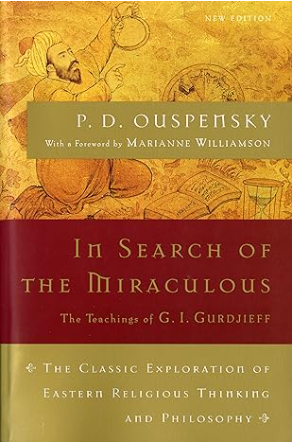

Peter Ouspensky
1878-1947
Pupil of G.I. Gurdjieff
“To see the roles, to know one’s repertoire, particularly to know its limitedness, is to know a great deal.”
From “In Search of the Miraculous” by P.D. Ouspensky: Roles
Recalling a meeting with Gurdjieff, Ouspensky wrote:
"The whole trouble is that you are quite sure that you are always one and the same," he said. "But I see you quite differently. For instance, I see that today one Ouspensky has come here, whereas yesterday there was another. Or the doctor--before you came we were sitting and talking here together; he was one person. Then you all came. I happened to glance at him and I see quite another doctor sitting there. And the one I see when I am alone with him you very seldom see.
"You must realize that each man has a definite repertoire of roles which he plays in ordinary circumstances," said G. in this connection. "He has a role for every kind of circumstance in which he ordinarily finds himself in life; but put him into even only
slightly different circumstances and he is unable to find a suitable role and for a short time he becomes himself. The study of the roles a man plays represents a very necessary part of self-knowledge. Each man's repertoire is very limited. And if a man simply says 'I' and 'Ivan Ivanich,' he will not see the whole of himself because 'Ivan Ivanich' also is not one; a man has at least five or six of them. One or two for his family, one or two at his office (one for his subordinates and another for his superiors), one for friends in a restaurant, and perhaps one who is interested in exalted ideas and likes intellectual conversation. And at different times the man is fully identified with one of them and is unable to separate himself from it.
To see the roles, to know one’s repertoire, particularly to know its limitedness, is to know a great deal. But the point is that, outside his repertoire, a man feels very uncomfortable should something push him if only temporarily out of his rut, and he tries his hardest to return to any one of his usual roles. Directly he falls back into the rut everything at once goes smoothly again and the feeling of awkwardness and tension disappears. This is how it is in life; but in the work, in order to observe oneself, one must become reconciled to this awkwardness and tension and to the feeling of discomfort and helplessness. Only by experiencing this discomfort can a man really observe himself. And it is clear why this is so. When a man is not playing any of his usual roles, when he cannot find a suitable role in his repertoire, he feels that he is undressed. He is cold and ashamed and wants to run away from everybody. But the question arises: What does he want? A quiet life or to work on himself?”